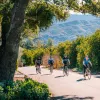
Planning your first biking adventure? Hear from a veteran Trip Leader about beginner-friendly cycling tips, gear recommendations and how Backroads provides the rider support, flexible route options and expert guidance to help cyclists of all abilities ride with confidence.
So, you learned how to ride a bike.
Likely this took place many years ago, but still—congratulations!
What’s that? You still don’t feel like a cyclist? Well, I’m here to tell you: there’s nothing to it. You’re right that there’s plenty more to know about cycling than just the act of riding a bike... but it’s easy to pick up with a bit of curiosity. Take it from me, as a staff writer, but also as a Trip Leader who’s led Backroads Biking Trips for over seven years.
That’s where this blog series comes in: to provide an orientation to all things two-wheeled. In Part 1, we’ll cover gear, preparations and some Backroads-specific biking logistics. Part 2 will soon follow, covering the mechanics of riding itself.
Who knows—soon you might get bitten by the bug… and graduate from armchair cyclist to a two-wheeled global traveler!
Levels & Difficulty
Let’s start by nipping the most common anxiety in the bud. “But Ben,” you say, “I can’t just learn to be a cyclist with a basic orientation in a blog post! It’s a whole sport, and I’m... (‘dun, dun, dun!’, goes the soundtrack...) SLOW!”
All Backroads trips are designed with a range of options for each day. And the general difficulty you can expect from that range is described by the trip’s Activity Level. Our Biking Trips are no exception.
There’s always a short option. And if you fall behind the group, your Trip Leaders always have tabs on where you are. E-bikes (available for guests age 16+) do a lot to help make up the difference, but whether you’re zooming along in Turbo mode or not, I need to emphasize: our trips support those who go slow!
Of course, you need to be in shape for a certain amount of activity, but general cardiovascular fitness goes a long way. Example: the numbers of miles in our daily distances may look daunting. But you’d be shocked to find how many miles you can do in a day when they’re split up with coffee breaks, support stops and, of course, Backroads meals.
Think of it like the number of daily steps you rack up in your favorite fitness app. If you translate that into miles and then set those stats to a hike–suddenly it can start to sound intense. Did you really walk all that in a day? But spread out across the day’s natural rhythm, you barely notice it. The same magic applies to a day out and about on a bike. It’s a far cry from the sustained workout of, say, a spin class.
Meet Your Backroads Bikes
In the cycling world, the main types of bicycles you’ll encounter are road bikes and mountain bikes. Mountain bikes are sturdier, made for intense bumping and jolting on trails, while road bikes tend to be lighter and built for speed. Hybrid bikes sit somewhere between the two. (We’ll table our discussion about BMX bikes, beach cruisers and other niche varieties.)
You might notice that “up” handlebars (the more or less flat kind) are common, while some road bikes have “drop” handlebars, which curve down at the ends. The advantage of drop bars, for those who are accustomed to them, is having a variety of places to rest your hands on long rides–some of them particularly ergonomic for racers. Meanwhile, up handlebars remain ubiquitous in mountain bikes because they allow easier access to brakes and steadier handling to trundle over rocky terrain.
All our Backroads bikes are road bikes. That said, we offer both types of handlebars, in the form of the choice between our performance and touring bikes. There is a slight trade-off in sturdiness and ease of handling (touring) versus lightness and speed (performance), but both bikes are extremely versatile. While some mountain bikers stereotype road bikes as precarious racing machines whose razor-thin tires can’t survive contact with a single pebble, this couldn’t be further from the case for our bikes. These road bikes gamely take on gravel, potholes and bumps!
A word about our e-bikes: they are pedal-assist e-bikes, meaning that you only get a boost when you’re pedaling. The motor multiplies the power of your pedalstrokes; it doesn’t have a throttle of its own. Though our e-bikes prioritize lightness over power–no freeway speeds here!–you will notice that an e-bike, especially our touring e-bike, is slightly heavier than its “acoustic” counterpart.
The most important thing to know about using your Backroads bike is: your Trip Leaders will show you! On Day 1, there are 15 to 30 minutes set aside not just for instructive talks, but for wheeling around in the parking lot and making sure you feel comfortable before you hit the road.
Kid-Bearing Tchotchkes
Backroads offers several novel methods of carrying little ones along for the ride when they–re not quite ready to ride their own bike yet.
One of them is a trailer bike—a one-wheeled bike with handlebars a child can hold onto, but don’t allow them to steer or brake. This attaches to the back of mom or dad’s full-size bike, creating a three-wheeled train where your kid is in the caboose. If junior doesn’t pedal, it’s double the workout!
For even younger kids, we offer a Burley Trailer Carrier. This attaches to the back of your bike, much like the trailer bike. But instead of something bike-like, it is a literal trailer, in which your kids ride seated as passengers (with helmets and seatbelts, of course).
About these two options, I’ll say this: if you’re not familiar with them, try them at home. Do not try them for the first time on a Backroads trip. Each contraption comes with its own set of wildcards when it comes to steering and handling, which you’ll gradually get the hang of if you choose to make them part of your family’s rides. We offer these devices so those who use them at home can come on vacation and bring their favorite setup along with them.
To Clip, or Not to Clip?
Why do some cyclists have their own pedals? These “clip-in” pedals attach to special cycling shoes with—you guessed it—clips on the bottom. Once you’re locked in, you can pull up on the pedal as well as pushing down on it, allowing you to activate more sets of leg muscles during each revolution and, the idea goes, more power.
The problem happens when you want to come to a stop. Unclipping from these pedals needs to be pretty second-nature for sudden dismounts to go smoothly. Every cyclist who makes the switch to clipping in will fall over while trying to unclip at least once—it’s a rite of passage! (Yes, I did it in front of my Backroads guests. I got it out of the way, and it never happened again.)
Many experienced cyclists swear by clipping in. But for many others, it’s a take-it-or-leave-it extra gadget. You can still have a fantastic ride on flat pedals. For these, the ideal shoes are any shoes with a flat, firm sole and a bit of tread.
Some cycling shoes, with their clips on the bottom, can scratch delicate parquet or stone floors. So in regions where cycling is a well-known sport, you may see “No cycling shoes” posted in winery tasting rooms, hotel receptions and so forth.
The Rub About Spandex
So what about those outfits?
I hate to break it to you, but everything ridiculous about cycling kits (as they’re called) has a practical use case. Spandex and Lycra shorts—butt padding is included—are truly the magic solution to enjoying long days in the saddle without chafing parts, an aching tailbone or other unwelcome side effects. On all our trips, we offer detachable seat cushions which drawstring to your seat... but they’re really only a Band-Aid on a problem to which cycling shorts are the well-established solution.
Shorts with attached suspenders that make them onesie-esque, called “bibs,” are useful because they keep the padding snug around the pertinent body parts. Mere shorts tend to ride down until the padding is bunched about between your thighs, resulting in a look worthy of a 2005 teenager, which sassy pros call “the diaper.”
Wearing padded shorts or bibs as underwear, hidden beneath more traditional outer shorts, is also a perfectly fine option. But don’t trust your shorts pockets: the up-and-down motion of pedaling is perfect to shimmy valuable items right out of there. You might as well wear the jersey too, since it includes nifty lower-back pockets. The bright colors of these kits have the added bonus of making you more visible to cars. Never seen a camo cycling kit? Now you know why.
Gloves are another item that some cyclists swear by. They protect your palms in the case of a fall, they prevent irritation that can result from squeezing the handlebars all day and the padding can reduce hand fatigue.
The look is completed by not-quite-dark glasses, because wind and bugs are a thing, even when the sun is not; and of course, the safety essential—a helmet. Don’t even think about riding without one!
If you just don’t feel comfortable in Lycra, you can have a great ride in all sorts of apparel. But I would encourage everyone to try out parts of the kit and see if you enjoy their benefits. Finding your perfect cycling gear should be a “yes, and” situation. Think of it like the clothes you wear to the gym. While some people work out in outfits that make them look sexy and fabulous—and good for them!—the majority are wearing what’s practical and comfortable to get sweaty in. And while the sexy dressers might steal the spotlight, everyone in the gym understands that the practical-dressing majority sets the tone. So, too, is the dynamic out on the road.
Stay tuned for Part 2 of this series, where we’ll dive into shifting, braking and rules of the road. Feeling curious about the doors a bike might open? Take a browse through our catalog of Biking Trips, easygoing Dolce Tempo Biking Trips or Multi-Adventure Trips with only a few days in the saddle. And if you’re reading this purely out of academic curiosity alone, and you know that biking isn’t for you… Our Hiking & Walking Trips are always waiting for you. With Backroads, there are just so many active ways to explore the world.