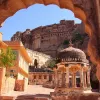
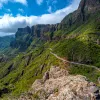
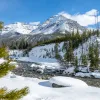
December opens a world of contrasts—sunlit shores in the Canary Islands, Colombia’s emerald valleys, Thailand’s gilded temples, the stark beauty of Death Valley and Antarctica’s vast, ice-carved horizon. Skip the predictable winter getaway and discover where adventure, wonder and inspiration come alive at year’s end.
For some of us, December is less about escaping winter and more about escaping routine, leaving predictability behind. If we’re going to go somewhere new, why settle for a lounge chair on a beach when we could witness nature, culture and wildlife at their most peculiar and spectacular? These five destinations remind us that we don’t just need somewhere to be–we need somewhere to be inspired.
Death Valley

Death Valley is a trickster, an exaggerator of truths. Just when it has convinced you it is a barren desert landscape, it shows you a small revelation, a fierce glimmer of life tucked into an improbable place.
At Badwater, the land sags nearly three hundred feet below sea level, and in this furnace of salt flats there appear stray pools of water, where you can spot wriggling pupfish no bigger than a thumb. Their rounded bodies turn, and blunt faces with cartoonish “puppy dog” eyes look up at you from below.
The valley floor is starkly beautiful with its brown and tan hues, but after a lucky winter rain, millions of seeds germinate at once. Acres of it erupt into sudden spreads of gold and violet blooms.
On Racetrack Playa, rocks ranging from tiny stones to 700 lb giants appear to have glided across the desert floor all on their own, leaving strangely determined trails across the cracked lake bed. It took many years for the explanation to be found: after winter, when the top layers of ice start to melt into separate sheets, the wind pushes them, and they in turn push the rocks, aptly named the “sailing stones.”
Lost pioneers, parched and scared, gave Death Valley its present name, but long before this, the native Timbisha Shoshone tribe saw it for its quirks and bursts of beauty. They called it Tümpisa, which translates to “rock paint,” a celebration of the swaths of red ochre that paint the walls in the valley.
Magic feels like this. Unexpected, startling, so strange it makes people laugh aloud together, awash with awe. To be fully immersed in it is unforgettable.
Visit Death Valley this Winter
Canary Islands

Far into the Atlantic Ocean off the shoulder of Africa, the Canary Islands extend outward like stepping stones atop a broad, slow current thick with marine life.
On the island called La Gomera, the terrain is riven by steep-sided valleys. The shepherds there, often finding themselves high on separate ridge tops without a way to communicate, created a whistling language that carried over the distances. Silbo Gomero sends shrill notes and changing pitches through the air to mimic the shapes of Spanish words. They are able to have full conversations this way, sometimes over a distance of three miles. When telephones and paved roads threatened to make the whistled speech a thing of history, the islanders claimed it as their heritage, making it mandatory in schools. In 2009, UNESCO declared it a Masterpiece of the Oral and Intangible Heritage of Humanity.
Needing a way to follow their herds up and down the cliffs, they also developed a sort of mountaintop parkour. Salto del pastor, the shepherd’s leap, is performed with a long wooden lance called a garrote. A shepherd plants the iron tip of the garotte against a sheer volcanic slope and launches himself outward, sliding and vaulting down ravines in great plunging arcs. Rocks rattle alongside them as they move with the easy confidence of creatures born into a largely vertical country.
A landscape can shape a people and bring about new forms of sound and movement so creative that they become cultural heritage, art forms in themselves.
Antarctica

Antarctica from a distance is glassy and still. Up close, it is a strange world, bristling with spurts of wild nature. Waterfalls run blood red from iron-rich glaciers, and penguins steal rocks from one another like small-town thieves. There are stretches of sea ice that squeal and whistle odd tunes beneath a ship’s hull, and in certain valleys, the air stays so dry that a dead seal can lie preserved for centuries with barely any decay.
There is deep knowledge here. Antarctica has become a vast archive of Earth’s climatic memory. Teams drilling ancient ice cores have recovered ice dating back more than a million years, and in some places nearly six million years. Tiny bubbles trapped inside preserve samples of prehistoric atmosphere, allowing scientists to reconstruct ancient carbon dioxide levels and temperatures with eerie precision. A new “ice memory sanctuary” at Concordia Station now stores these cores, preserving them for future generations.
The ice glows blue from deep within, so glaciers and caves can look lit from the inside, and the silence is legendary. Travelers describe moments with literally no sound, not even the distant hum of civilization.
In Antarctica, people feel like they have stepped outside of the planet, outside of any norms. “Like another world” is a phrase the glacier walls have echoed many times.
Colombia

Colombia is a catalog of deeply rooted traditions and displays of natural beauty.
In the mountain villages, farmers still transport milk cans by cable lines strung over perilously deep ravines. They swing and sway over the abyss.
In the village of Barichara, the old men still play a game called tejo, wherein points are scored by throwing iron weights at packets of gunpowder until they explode. Spectators instinctively lean backward before applauding.
It is required by law for all national radio and public television stations to play the Colombian national anthem every day at exactly 6:00 a.m. and 6:00 p.m. When you travel there, your cultural soundtrack has one song already in place, and it will be joined during the day by the birdsongs of over 1,900 species—more than Europe and North America combined.
The “River of Five Colors,” Caño Cristales, turns shades of red, yellow, green, blue and black thanks to an aquatic plant that blooms beneath the water. For a few months each year, it offers a free-flowing rainbow display.
In Medellín, high in the mountains, the climate remains so steady year-round they call it the City of Eternal Spring. Lightning storms take over skies over the Catatumbo River, flashing nearly every night of the year, flickering so constantly sailors once used them as navigation beacons.
Thailand

Thailand is a place where the marvelous and the mundane stand side-by-side in the same town, even the same stretch of sidewalk.
At the Mae Klong Railway Market, vendors calmly sell fish and mangoes directly on the train tracks and whisk everything aside moments before the locomotive squeezes through.
In Bangkok, monks in saffron robes glide past neon-lit malls and teenagers carrying bubble tea, while beneath the city an entire network of monitor lizards patrols the canals and parks like leftover dinosaurs adapting remarkably well to urban life. The capital’s full ceremonial name, recited in proper form, runs so long it could nearly outlast a traffic light, and schoolchildren memorize it the way ranch kids elsewhere learn ball scores. At certain markets, fortune tellers sit beside mechanics and noodle vendors, offering predictions between bowls of soup and scooter repairs as though glimpses into destiny were simply another neighborhood service.
While nighttime routines go on as usual in the mountain towns around Chiang Mai, their lantern festivals send thousands of floating lights drifting into the night sky like a lilting parade of fireflies. Caves filled with millions of bats empty out as they spiral into the evening sky in columns so vast they seem to form rising plumes of smoke.
Winter can be wondrous, and December can be filled with the unexpected and divine, if you just know where to go.