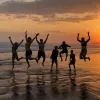
Outdoor group travel creates meaningful connections through shared adventures, turning hikes, bike rides and new experiences into lasting memories. Whether traveling solo, as a couple or with family, guests often discover that the people they meet become as memorable as the destination itself.
At the end of a six-hour hike traversing Osorno Volcano in Chile’s Lake District, our group gathered around the cooler beside the Backroads van. Everyone was tired, hungry and ready to return to Hotel AWA, where five-star comfort awaited after a long day on the trail.
But they were also laughing. A lot.
Water bottles and cold drinks were passed around as everyone retold moments from the hike. By that point, I could no longer tell who had arrived together. The couples had dissolved into one big group of friends, all talking over one another and sharing the satisfaction of what they had just done.
Six hours earlier, they had set off in couples and small clusters. By the time we reached the van, those divisions had disappeared.
That is what outdoor group travel can do.
I Used to Think Group Travel Sounded Cringey
As a Brit, I used to find the idea of group travel slightly cringey. I imagined forced socializing, organized “fun” and being instructed to make friends with a room full of strangers.
I love traveling, but I also like my independence. The idea of spending every meal and activity with a group did not appeal to me.
Then I started leading active trips.
What I found is that group travel feels very different when the group is outside. You are not sitting in a circle being asked to take part in an icebreaker. You are walking through the Swiss Alps, cycling between Dutch villages or stopping for a picnic with a view of a volcano.
The experience comes first. Then relationships form around it.
There is always something to look at, something to do or somewhere to go. Conversation has a natural rhythm. You might talk to someone for half an hour as you climb, walk quietly for the next section and then find yourself beside someone completely different after lunch.
Nobody has to perform socially. You simply start moving, and the group begins to take shape.
Many Guests Arrive Nervous
On a trip through the Netherlands and Belgium, one of our solo travelers expressed her nervousness to my co-leader and me almost as soon as she arrived.
She was skeptical about the group dynamic and unsure how she would fit in. This is more common than people might think. Even confident, well-travelled guests can feel apprehensive when they arrive alone and see other people checking in with partners, friends or family members.
But by the end of our first dinner, she had slotted right in.
The anticipation had been far more uncomfortable than the reality. Once everyone was sitting around the same table, sharing food and talking about the days ahead, it became clear that she was not the only person interested in meeting someone new.
People do not necessarily book a group trip because they want to spend every moment with the person they traveled with. Often, they want to meet people beyond their partner, friend or family member. The group adds something they could not create alone.
A solo traveler may worry that everyone else will remain in their existing pairs, while couples may wonder whether they will connect with the wider group. In practice, the outdoors constantly rearranges people. Different walking speeds, shared interests, route options and seating plans create dozens of natural opportunities to talk.
By the second or third day, the original groupings matter much less.
Shared Effort Creates Connection
Outdoor trips also give people something genuine to experience together.
At Oeschinensee in Switzerland, parts of the hiking trail require extra concentration. There may be uneven ground, exposed sections or rocks that need to be approached carefully.
When one person notices something on the trail, they pass the message back.
“Watch out, this rock is wobbly.”
“Take the higher step here.”
“Mind your head.”
The warning moves along the line, from one guest to the next. It is a small act, but it changes the group dynamic. People begin looking out for one another.
Nobody has been told to do it. It happens naturally because everyone is moving through the same landscape and wants the people behind them to get through safely.
Shared effort does not have to mean extreme hardship. It might be a long climb, a sudden rain shower, a strong headwind or simply the final hour of a tiring day. These moments give a group its own collection of stories and jokes.
In everyday life, it can take weeks to build the familiarity that develops during one full day outside. By dinner, people are no longer searching for conversation topics. They are discussing the climb, the weather, the descent, the view and the snack that got them through the last few kilometers.
Different Abilities Do Not Divide a Group
One of the biggest concerns guests have about active group travel is fitness. They worry about being the slowest, holding others back or feeling pressured to complete an activity that is not right for them.
But one of the advantages of a thoughtfully planned active trip is that success does not have to look the same for everybody.
I once helped lead a multigenerational family through the Swiss Alps. The group included an 85-year-old grandmother traveling with her children and grandchildren.
She joined the hikes where she could. Sometimes she took a gondola down early. On other days, she skipped part of an uphill section so that she could meet the group later and still enjoy the best parts of the experience.
The aim was not for everyone to complete identical distances. It was for the whole family to share the journey while making choices that kept everyone safe and allowed them to have fun.
Different abilities can actually add to a group rather than detract from it. One person may be quick on the climbs. Another may be calm on technical terrain. Someone else may bring the energy when everyone is tired. The strongest athlete is not always the person contributing the most to the day.
You Can Still Have Space
Being part of a group also does not mean socializing constantly.
There are stretches of a hike when people naturally spread out. Some guests walk in conversation, while others enjoy the scenery quietly. On a bike, you might ride beside someone for a while and then settle into your own rhythm.
At the hotel, you can rest, read, swim or have time to yourself. On the trail, choosing the shorter option one day does not make you less involved in the trip. That flexibility is one of the things I now love about group travel.
You do not need to spend hours researching every transfer, trail, restaurant and route. You only need to decide whether you want the long option or the short option that day. Your Trip Leader will tell you where to be, when to be there and what to bring. Removing that logistical burden leaves more space to experience the destination itself.
Other People Expand the Experience
Travelling with a group also introduces perspectives you would never have encountered on your own.
One guest may know about local plants. Another may notice architecture, geology or birds. Someone might ask a question that changes the way everyone understands the landscape.
As someone who studied archaeology and loves food, I am naturally drawn to the history of a place and what people eat there. But another traveler may see the same destination from a completely different angle. Their curiosity adds another layer to my own experience.
You may begin the day looking forward to a particular viewpoint and finish it remembering a conversation you had on the way there.
That is the surprising thing about group travel. The destination remains important, but the people become part of how you remember it.
The Big Difference Is Laughter
Not every group becomes a collection of lifelong friends. Some guests stay in close contact, while others return to separate lives. But almost every trip changes between the first meeting and the final goodbye.
At the beginning, people are polite. They ask where everyone is from and try to remember names. By the end, they are sharing snacks, repeating private jokes and laughing about moments that would make very little sense to anyone outside the group.
There is simply more laughter.
Outdoor group travel works because connection is not the scheduled activity. It is a by-product of moving through a place together.
You do not have to arrive knowing how to belong. You begin walking, riding and sharing the experience, and somewhere along the way, the group forms around you.
Want more travel stories and tips? Sign up for our emails:
More Travel Inspiration