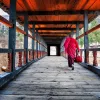
Prayer flags. Mountains. A small country tucked between two of the world’s most populated countries. As I lie in bed the night before leaving on my Backroads Bhutan Women’s Hiking & Walking Tour, these are the images dancing in my head.
Bhutan is often spoken about in superlatives—its devotion to happiness, its fiercely protected culture, its dramatic Himalayan landscape. I knew all of this before going. But nothing prepared me for the experience of hiking through this country in the company of a group of adventurous women. This journal captures that journey.
Day 1: Bangkok -> Paro
First Impressions and Temple Visits
At 6:34am, we’re taxiing down the runway as the sun rises over Bangkok, officially on our way. It’s a feature of traveling with a group of women: before the plane takes off, we already know not just names, professions, travel history of everyone in our group, but also—thanks to our Backroads leader, Mitra—our Chinese zodiac signs, elements and colors. She’s strategically secured seats for us on the right side of the plane so we can catch unfiltered views of the Himalayas and Mount Everest as we glide into Paro airport.

The sign that greets us as we enter the terminal is a prescient one: Bhutan, Believe. It sets the tone for the week ahead.
We board the Backroads bus and meet Uncle Tenzin, our driver extraordinaire, and Tharchen, our Bhutanese guide (equally extraordinaire), and head to the trailhead for a two-mile hike to Drakarpo temple.

Breathing in the crisp and clean air, I pass through a village and see vibrantly colored chili peppers laid out to dry on the rooftops of houses. At the temple, we walk through a fluttering column of prayer flags and pause to take off our shoes before entering. Together, we make an offering and enjoy a quiet moment while listening to the chanting of the monks.

Descending from our hike, we arrive at a gorgeous picnic spot in the shade of an evergreen grove. We enjoy a vegetarian lunch of red rice and veggies, dumplings and salad, followed by a short ride to our hotel and some post-travel downtime.
Day 2: Paro -> Punakha
Bhutan’s Past, Present and Future
This morning, I’m trying to wrap my head around the concept of Bhutan’s planned Mindfulness City in Gelephu. It’s a bold and noble idea—to create, from the ground-up, a city that integrates sustainability, Bhutanese culture and business-friendly regulations—and my jaded Western mind doesn’t quite know what to make of it. Can a small kingdom between China and India pull it off? (Answer: Believe). Whatever the future may hold, I’m envious of a country with so much hope and optimism.

On our bus ride between Paro and Punakha, we stop at Dochula pass to visit the 108 chorten (sacred Buddhist monuments) built to honor the Bhutanese soldiers killed in the 2003 battle against Assamese insurgents from India—a sobering reminder of Bhutan’s modern history.

Our next stop is a homemade lunch at a monastery and the chance to mold a tsa tsa, a miniature conical clay stupa, often mixed with ashes and placed in makeshift roadside shrines as an offering. Bellies and minds full, we head off on an eight-mile afternoon hike along the Trans Bhutan Trail before arriving at the Dhensa Resort, our Punakha home for the next two nights.
Day 3: Punakha
Transience, Temples and the Shade of the Bodhi Tree
Wild dogs bark much of the night in the valley below our hotel, riling each other up and stirring up my dreams as well. As the valley finally quiets, my thoughts drift to how Bhutan marks the passage of a life. All over the country, white prayer flags, often in clusters of 108, symbolize purity and honor the deceased. They dot the landscape, spreading blessings in the wind. Chorten and tsa tsa shrines are everywhere. Unlike a Western cemetery, these integrated memento mori serve as ever-present reminders of our transience.

Waking up in Punakha, I feel as if my journey has just begun. Mary Oliver’s words ring in my ears: What is it you plan to do with your one wild and precious life?
Two cups of coffee and a fabulous breakfast later, we’re ready to begin the day with a tour of the impressive Punakha Dzong Buddhist temple. Our timing is perfect, as hundreds of monks are gathered when we arrive. Their chants and chimes fill the space, and we sit on the sidelines to take it all in, including the youngest monks who shift and giggle in their seats.

Our afternoon hike leads us to the Queen’s Temple, where we’re given a tour by the son of the artist who painted the murals that line the interior walls. He and his two brothers allow us to watch as they paint delicate and colorful mandalas in the shade of the bodhi tree.
Day 4: Punakha -> Thimphu
Pushing My Boundaries, Bhutan-Style
White-knuckled, I inch my way across the hundred-meter-long suspension bridge in Punakha, feeling every bounce and shift in the wind. Tharchen senses my impending vertigo and guides me to the other side. I’m grateful for the steady hand and beyond relieved to join the photo op with the group at the far end of the bridge.

We hike five miles along the banks of the river, dodging fresh cow pies in the light rain, and arrive at the put-in spot for our rafting trip down the Pho Chhu River’s Class I-III rapids. The cold river shocks us awake; the laughter warms us back up. Our rafting guide knows this river well, carefully navigating each one of us into the most splash-worthy twists and turns so we are equally soaked.

Back on the curtained bus, we change into dry clothes like ladies in a locker room, then head to an outdoor lunch overlooking the river and the Punakha Dzong fortress-monastery. In the afternoon, we drive back over the mountain pass to Thimphu and check in at the elegant Pemako Thimphu hotel, where the staff has laid out kiras (long dresses for women) for us to wear for our at-leisure evening.
Day 5: Thimphu
Making Room for the Magic of Bhutan
Today is a day of celebration—one of the women on the trip turns 50 today. Her birthday turns out to be the harbinger of many blessings; the first of which comes from the head monk at the Temple of Reincarnation. The interior of the temple is dominated by a golden Buddha. The monk touches a white scarf to the Buddha’s outstretched hand before placing it around each of our necks. He gives us each a green Tara Buddha necklace and wraps colorful strings around our wrists before serving us tea and biscuits. He laughs with us, and his joy is infectious.

We hike back to the hotel for a quick change followed by Chinese food, birthday cake and a brief tour of the city. We celebrate on our own tonight with a dinner of momos (Bhutanese dumplings) in honor of our birthday girl. A cranky American tourist approaches our table, wanting to commiserate about the weather and offer his skepticism about Gross National Happiness, given the low wages and simple lives of rural Bhutanese. It’s a fair observation, but from my perspective, he’s missing the point. As I reflect on the day, the realization lands: to fully appreciate Bhutan, you need to leave your Western mind at home and simply accept this different world view and pace of life.
Day 6: Thimphu -> Paro
Misty Buddhas on a Rainy Day
We wake to rain and as a group decide to forgo our hike and instead drive to Thimphu’s Big Buddha, Dordenma, which stands 169 feet tall. As we arrive, the statue is shrouded in mist and preparations are in full swing for the Global Peace Prayer Festival that starts in three days.

In anticipation of the event, the local community has erected a makeshift temple in the plaza, which is surrounded by mannequins, dressed in traditional garments like ghos (the robes that men wear) and kiras adorned with community-donated jewels. We tour the temple, which is lined floor-to-ceiling with small Buddha statues blessed by the monks.
Namgay, the founder of Namgay Adventures, joins us for lunch in tribute to his 20+ year relationship with Backroads. After lunch, we drive back to Paro and walk through town to shop and get warm drinks at the Mountain Café. We check in at the fabulous Zhiwaling Heritage hotel and walk to a nearby restaurant for a comforting meal of pho. It’s the perfect choice to end a rainy day.
Day 7: Paro
Yoga Setting the Stage for a Perfect Pivot
I start the day with morning yoga in Zhiwaling’s Samden Meditation House facing the famed Tiger’s Nest monastery, which hangs on the cliff like a secret peeking through the clouds, just out of reach. As luck would have it, it will remain so for me, at least on this visit. Out of an abundance of caution for the safety of visitors, the steep mile-long trail to the Temple is closed by the Bhutanese authorities because of the rains.

Our group takes it in stride, and our leaders are quick to find an alternative walk in Paro to visit a dzong fortress-monastery followed by a picnic lunch and afternoon visit to the Zhiwaling tea house.
After bidding farewell to Tharchen and Uncle, we gather for a farewell dinner to share our recollections and celebrate the new friendships we’ve made along the way.
Day 8: Paro -> Bangkok
Saying Goodbye to Bhutan
We wake up early for a final yoga session at Zhiwaling, then breakfast and a ceremonial blessing to carry us on our way. One member of our group stays behind to complete the climb to Tiger’s Nest, rearranging her extended stay to see the monastery. The rest of us board our flight and settle into our window seats for another uninterrupted view of Mount Everest.

As the plane lifts above the Himalayas, I feel a familiar ache—the kind that comes from saying goodbye to a place that has quietly reshaped you. Our group arrived as travelers but left with something deeper: a renewed sense of curiosity, connection and gratitude. Bhutan may be small, but its impact is anything but. The Kingdom of Hope lives on in the stories we now share.