Banff is no ordinary mountain town. With fewer than 10,000 permanent residents, it sits inside Canada’s first national park—a place where jagged peaks, rushing rivers and quiet forests frame daily life. Long before trains and tourists arrived, the area was home to the Stoney Nakoda, an Indigenous people of the Canadian Rockies who traveled these valleys for centuries. In 1885, the creation of Banff National Park brought a new wave of people, and the town quickly became a magnet for explorers and adventurers year-round.

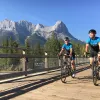
Today, Banff’s streets buzz with cafés, galleries and shops, but the wild is never far away. Trails begin at the edge of town and wind into the forest, gondolas rise to panoramic viewpoints of the surrounding areas and emerald lakes shimmer a short road trip beyond. Few places in the world balance small-town scale with such staggering grandeur.
Canada’s Castle in the Rocky Mountains
If Banff is the heart of the Rockies, the Fairmont Banff Springs is its crown jewel. Opened in 1888 by the Canadian Pacific Railway, the hotel was built to establish the West as a world-class resort destination. Its soaring stone towers, turrets and gables were meant to impress wealthy travelers arriving by rail—and they did. From the start, the Banff Springs was celebrated as one of North America’s premier luxury retreats, where wilderness and indulgence met in a single, spectacular setting.

The design evoked a medieval castle, perched above the Bow River Valley with peaks on every side. Over the years, it has been expanded, modernized and even rebuilt after fires. But it has never lost the grandeur that earned it the nickname “Canada’s Castle in the Rockies.” Step through its doors today, and you’ll feel that history layered with modern elegance, where architecture and sweeping mountain views create a sense of timeless grandeur.
A Railway Vision

The Banff Springs was the first jewel in what became a chain of grand resorts built by the Canadian Pacific Railway (CPR). Company President William Cornelius Van Horne put it plainly: “If we can’t export the scenery, we’ll import the tourists.” To fill trains and showcase the young nation, CPR built destination hotels to rival Europe’s finest, pairing wilderness with the polish of old-world elegance.
What followed was a series of château-style landmarks that reshaped Canadian travel. The Château Frontenac in Québec City rose high above the St. Lawrence River, The Empress in Victoria looked out on the Pacific, and Château Lake Louise offered alpine drama to rival Switzerland. More than hotels, they became national symbols—architectural statements designed to awe visitors and inspire pride at home.

By the mid-20th century, the properties were formally united as Canadian Pacific Hotels, a collection that defined luxury in Canada. The acquisition of Fairmont Hotels in 1999 gave the group a new global identity, and today—under the Accor banner—these historic Canadian resorts remain the signature properties of the brand, enduring testaments to a vision that began with rails and rose into castles.
Inside the Fairmont Banff Springs
Step through the doors of the Banff Springs, and the sense of scale is immediate. The grand lobby echoes with the history of aristocrats, adventurers and dignitaries who once walked these halls. In its early decades, a stay here was an event in itself. Wealthy travelers arrived by rail to find a castle rising from the forest, their first-time glimpse of the Rockies unfolding before them. Inside, ballrooms and dining halls set the stage for evenings of elegance.

The hotel was conceived as a full resort experience, not merely a place to sleep. Guests soaked in hot springs, dined in formal attire, danced in the ballroom and took sightseeing carriage rides through the valley. Even the journey was part of the allure: luxury rail cars carried travelers westward, with the Banff Springs as the ultimate reward. From the start, it was this balance—wilderness by day, refinement by night—that defined the Banff Springs and helped shape Banff’s identity as a destination unlike any other in North America.
Banff & the Fairmont Today
More than a century after it first opened, the Fairmont Banff Springs continues to define luxury in the Canadian Rockies. Its castle-like silhouette still dominates the Bow Valley, but inside, the experience has evolved to meet the expectations of modern travelers. Rooms are elegant and refined, many with mountain views or fireplaces that add a cozy counterpoint to the alpine air outside.

The Willow Stream Spa has become a sanctuary of thermal pools, relaxation spaces and treatments inspired by the surrounding landscape. Dining is just as memorable, with venues ranging from fine Canadian cuisine to casual après-ski cocktails. Beyond the walls, gardens, terraces and walking paths frame views of the peaks while guests tee off on a championship golf course in the summer months or hand their skis to the concierge in winter.

Today, the Banff Springs is both indulgence and gateway. Hikers venture out to trails, lakes and summits by day, then return to the hotel for evenings of comfort and refinement. That blend of wilderness and hospitality has kept the Banff Springs at the heart of the town’s identity for generations.
Planning Your Banff Itinerary
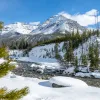
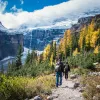
For travelers today, the essence of Banff lies in the balance between wilderness and comfort. A morning hike around Lake Louise or a ride along the Icefields Parkway reveals some of the Rockies’ most spectacular scenery, from turquoise lakes to sweeping glaciers. In winter, snowshoeing trails and frosted valleys reveal a different face of the park—crisper, quieter and just as breathtaking.

As evening falls, some slip into the hot springs or the spa, while others wander town or watch the mountains fade into silhouettes against the night sky. Mountain-view dining, fireside drinks and stargazing in the alpine air remind you that Banff doesn’t rest when the sun goes down—it simply shifts its rhythm.
What sets the town of Banff apart is this seamless blend of wilderness and welcome. At its heart, the Fairmont Banff Springs continues to anchor the experience, offering travelers a place where adventure by day meets hospitality by night. When you visit Banff today, you can still feel what those early aristocrats did: awe at the Rockies rising all around, and the thrill of finding a castle waiting in the wilderness.