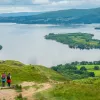
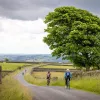
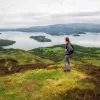
England—a land with tales that are told throughout ancient history, folklore and legends. You’ve probably heard of places such as Yorkshire and the Cotswolds, and you’ve even stopped in London for a few nights, right? But in the top northwest of England lies arguably the most beautiful national park in the whole of the United Kingdom: the Lake District. This area, referred to as Cumbria, is one of the biggest outdoor capitals of the UK and boasts huge mountains and hundreds of waters, lakes and tarns, all interconnected by gushing rivers and waterfalls. As a Lake District local, I’m here to tell you why this UNESCO World Heritage Site should be your next travel destination—but maybe not for the reasons you expect.
The pure beauty of the Lake District is something that many claim as indescribable. But that doesn’t mean that many famous creatives haven’t tried. When you stumble across a picturesque English farmhouse on a mountainside, could you almost imagine Peter Rabbit trying to steal carrots from Mr. McGregor’s garden? Well, back in the early 1900s, so could Beatrix Potter herself, which is why the majority of the Peter Rabbit series was written in the Lake District whilst Beatrix Potter holidayed here every summer.

Or maybe you are taking a hike along the quiet shores of Lake Grasmere after coming out of the word-famous Grasmere Gingerbread shop and you stumble across Dove cottage, the poet William Wordsworth's home, and the source for some of his most famous work.
The Lake District is well known for being one of the most inspirational regions in the UK, and so, in addition to William Wordsworth and Beatrix Potter, authors and art critics such as Arthur Ramsome, John Ruskin and Samuel Taylor Coleridge resided and wrote here. The Lake District is widely known historically as the cradle of many famous English writers and creatives. But even today, it’s hard not to be inspired by its picturesque landscape and scenery. In fact, when hiking it is common to come across locals partaking in sketching or watercolor painting of the landscape.
However, the scenery of the Lake District is totally different from its neighboring county of Northumberland, or even the Scottish Highlands. The area is compact but holds all of England’s peaks over 3,000 ft, which are connected by ribbon-shaped valleys. Carved out by glaciation, these valleys are filled to the brim with lakes and waters—16 major lakes and waters if we’re being specific! These, of course, get topped up by that famous English rain, but that is also why our landscape is so lush and green. It is also why as Brits we love a warming drink and a roaring fire in a pub!
If you want to speak like a local, you’d call the mountains “fells” and you would call the mountain lakes “tarns”, which both derive from old Norse words fjallr and tjorn, dating back to Viking invasions of the UK. All of these valleys and mountains are dotted with Herdwick sheep and lambs, ancient drystone walls and, in the late summer, bright purple heather. You’ll even often stumble across farmers herding their sheep with their traditional border collie sheepdogs.

As locals, we love our home, and most of us partake in outdoor activities every weekend. It is our way of socializing, even during the winter when it is dark and rainy! There is a Lakeland tradition of “fell running”, which is a slightly more intense version of trail running. Every summer weekend, each village will host a different “fell race”, with runners racing over various peaks before finishing with a well-deserved pint and maybe even a pork pie!
However, if running isn’t your thing, why not join us locals for a “wild swim”? And no, that’s not in an indoor pool! As locals, we get together in groups to swim in all weather and all seasons in our lovely lakes! Think you’ll get chilly? That’s why we wear woolly hats and special gloves and booties! We love our swimming, and there’s nothing better to get the blood flowing than a chilly dip after a hike. What makes this practice even more British is the custom of bringing a thermos of tea or coffee as well as a slice of cake to share with your friends on the lakeshore after you finish swimming.
If you don’t fancy the idea of fell running or even wild swimming, you’ll be happy to hear that the Lake District is a hiker’s paradise. In total, there are 214 different “Wainwrights”, which is the name given to Lake District mountains over 1,000 ft. Now, I know that doesn’t sound high; however, that is the true beauty of hiking here. You can walk for a mile along the shore of lake Windermere, taking in Wray Castle whilst surrounded by mountains. Or, you could have a huge day out and start from a lake, work your way up a mountain and summit up to 15 different “Wainwright tops” in a day. In other words, there truly is hiking for all levels. There is such a variety of scenery here that even after living in the region for years, every weekend I can still find somewhere new to explore.

The hospitality industry has happily kept up with the region's growing popularity, producing some of the nicest fine dining establishments in the country as well as modern luxury hotels such as The Gilpin, placed in stone-built towns. Northern English hospitality is famously warm, and whilst sometimes our northern British accents aren’t quite as clear cut as those in London, what you will understand is us offering you a proper Cumbrian ale and sticky toffee pudding to eat by that roaring fire.
For me, the Lake District is home. It is mountains, swimming, good coffee by the lake and endless hiking. But for first-time visitors, it is a land of mystery and wonder, with brand new stunning views around every corner. Because of its mountainous geography, accessing some corners of this region can be difficult without a car, and because the roads are tiny and we drive on the left, tourists are often put off. This isn’t to say it isn’t worth visiting; if anything, it’s worth visiting more, because there are sections of the Lakes that are totally untouched! The majority of visitors to the Lake District are British, coming on a romantic weekend away or bringing kids to experience sailing, hiking and kayaking. People come to this part of our lovely country to escape busy daily life. And for this reason and so many more I encourage you to come and experience the culture, the hiking, the food, the landscape and the true beauty that is Cumbria—England’s Lake District.